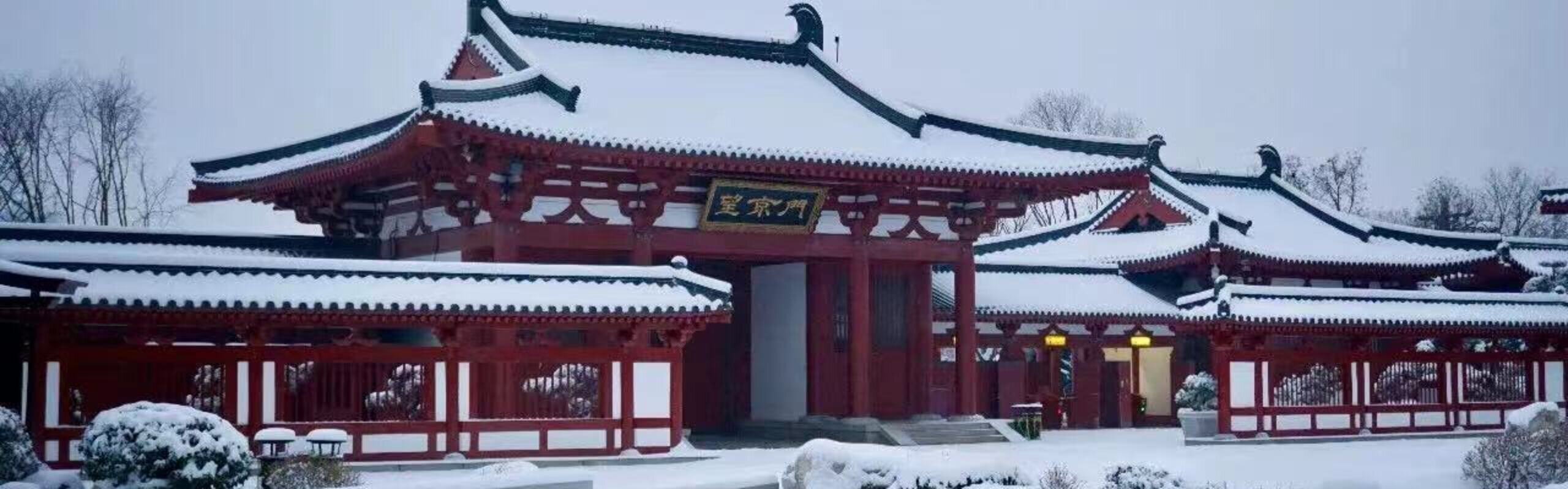

As a local tour guide who has been to Huaqing Palace, also known as Huaqing Pool, many times, it holds a special place in my heart. Every time I lead tourists there for a visit, it's like a journey through time and space, allowing me to immerse myself in the rich history and feel the afterglow of the prosperous Tang Dynasty.
It is known as one of the Four Great Royal Gardens in China along with the Summer Palace, the Old Summer Palace, and the Chengde Mountain Resort.
This charming place bears the romantic love story of Emperor Li Longji, the seventh emperor of the Tang Dynasty, and his beloved concubine Yang Yuhuan. On December 12, 1936, the Xi'an Incident, which shocked China and the world, also took place there. Chiang Kai-shek, the chairman of the Kuomintang, was arrested in the Five-Room Hall of Huaqing Palace.
If you are familiar with and fond of Chinese history, you are advised not to miss it. However, if you are not very interested in history but prefer natural landscapes and have already visited the Summer Palace in Beijing, you could consider skipping Huaqing Palace, because the Summer Palace has more beautiful scenery.
Facts about Huaqing Palace:
- Opening hours: 7:30am to 6:30pm
- Ticket price: 120 yuan
- Recommended visiting duration: about 2 hours
- Location: 40–50 minutes' drive from downtown Xi'an

Hi, I'm Mervyn, born and raised in Xi'an. Over the past 30-40 years, I've witnessed the city's remarkable transformation, from its streets and buildings to its culture and lifestyle. Since 2010, I've been a local tour guide, catering to diverse groups with varying needs. I love sharing Xi'an's stunning scenery, authentic local cuisine, rich history, and traditional architecture. I look forward to meeting you here!
Content Preview
- Why Was It Built?
- Best Things to Do
- The Suggested Traveling Route
- Can I Enjoy Hot Springs?
- Best Times
- Transportation
Why Was Huaqing Palace Built?
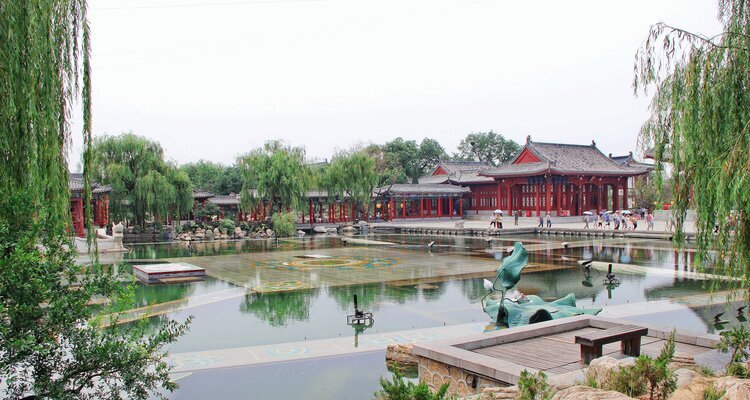 Huaqing Palace
Lishan Mountain, where Huaqing Pool is located, has high-quality hot spring resources. The ancient Chinese believed that hot springs had the effects of treating diseases and maintaining health.
Moreover, they had a sense of awe and worship toward natural phenomena and thought that hot springs were gifts from the gods.
Building bathing pools near hot springs had the functions of enshrining the hot spring god, offering sacrifices, and praying for blessings, hoping to obtain the protection of the gods in this way to ensure the peace and prosperity of the country and the imperial family.
Therefore, emperors of various dynasties built imperial palaces and gardens there to use the hot springs for bathing, recuperation, and praying for blessings.
- During the Western Zhou Dynasty, King You of Zhou built a stone pool there named Lishan Tang.
- In the Han Dynasty, it was expanded into a large palace, namely Ligong.
- In the Tang Dynasty, Emperor Xuanzong built a magnificent palace city around Lishan Mountain, named Huaqing Pool. The name "Huaqing" symbolizes the beauty and clarity of the hot springs. Emperor Minghuang and his concubine Yang Yuhuan bathed there for 8 years.
Best Things to Do in Huaqing Palace
I think there are three major sections to visit inside Huaqing Palace:
The Site of the Xi'an Incident (Huan Garden and the Five-Room Hall)
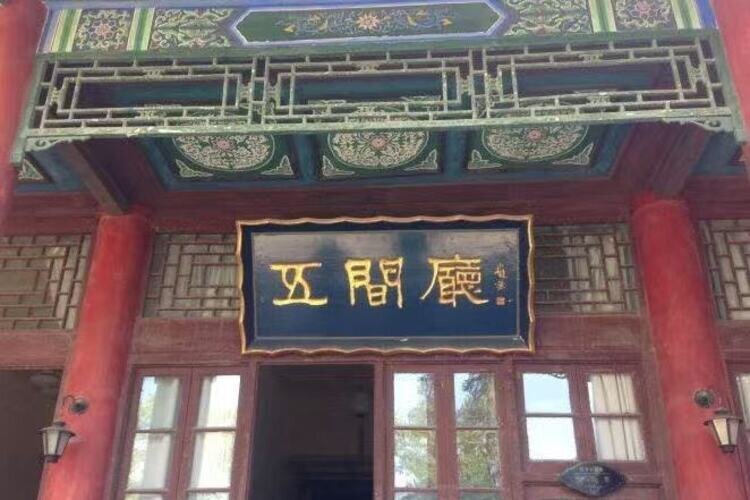 Five-Room Hall
Enter through the east gate of Huaqing Pool and go up the steps. The section in the middle is Huan Garden, a small garden built in the late Qing Dynasty. There are pavilions, terraces, small bridges, and flowing water in Huan Garden, with beautiful scenery.
Both Empress Dowager Cixi and Chiang Kai-shek once lived there. Further back is the Five-Room Hall, the place where the Xi'an Incident took place.
Chiang Kai-shek lived there at that time. The bullet marks from the fierce battle at that time still remain on the outer wall of his bedroom, and the beds and sofas in the bedroom are also well preserved, vividly reproducing that thrilling moment.
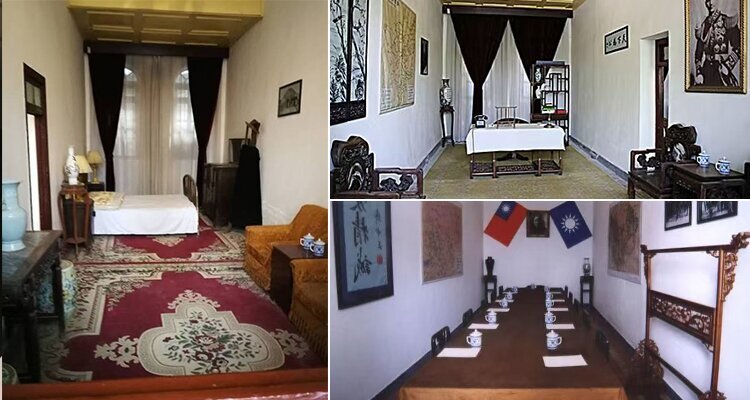 Chiang Kai-shek's bedroom and workplace
Go down from the Five-Room Hall and exit through the back door, then take an electric vehicle to the mountainside and you could see the tiger-striped stone where Chiang Kai-shek hid when he fled and the Bingjian Hall.
The Royal Hot Spring Pool Museum
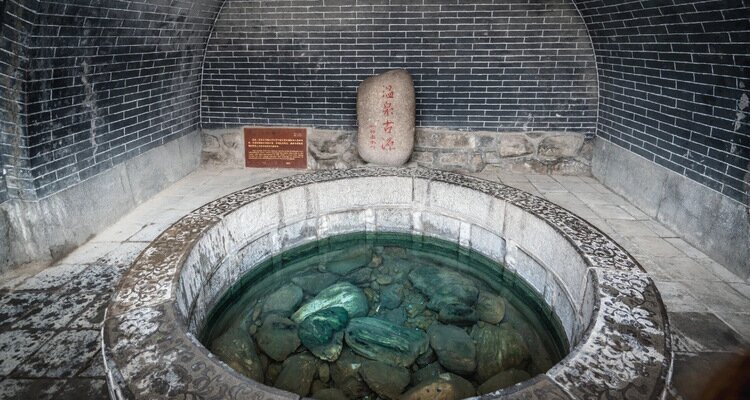 Huaqing hot spring water source
Walk west from Huan Garden and you would reach the Imperial Hot Spring Relics Museum.
There, the remains of five Tang Dynasty royal hot spring pools are preserved, including the sites of the hot spring pools used by Emperor Taizong Li Shimin, Emperor Xuanzong, Yang Yuhuan, and others.
There, you could also see the source of the hot spring water. At the third hot spring water source, you could also feel the temperature of the hot spring water and its nourishing effect on the skin. Standing there, I am always amazed by the elegance of the Tang Dynasty imperial family.
The Place Where the Li and Yang Love Story Took Place
Walk west from the Imperial Hot Spring Relics Museum and you would reach the Frost Flying Hall (the bedroom hall of Li and Yang at that time), Nine-Dragon Lake, and the Longevity Hall. Every plant and tree there is a witness to this love story.
Lishan Mountain
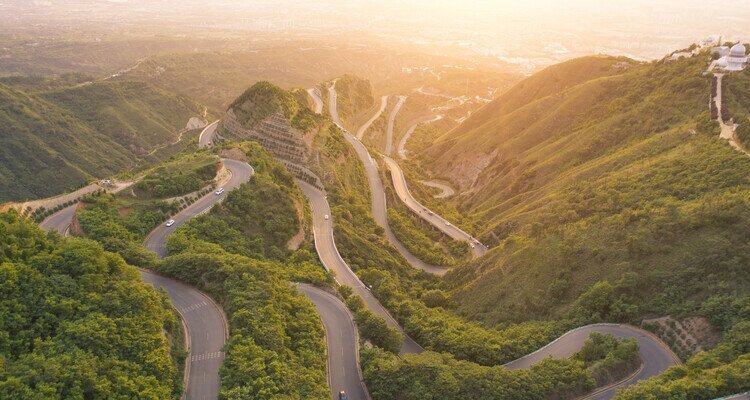 lishan Mountain
If you have enough time (if you could finish visiting Huaqing Palace before 3pm), Lishan Mountain behind Huaqing Pool is also worth visiting.
Lishan Mountain has a maximum altitude of 1,302 meters (4,272 feet). Standing on Lishan Mountain, you could overlook the scenery of the entire Huaqing Palace and the Lintong District.
You could take an electric vehicle from the east gate or take a cable car behind the west gate to climb Lishan Mountain.
By taking an electric vehicle, you could only reach the mountainside and then you still need to climb a large part of the mountain, which is quite time-consuming (taking about 2–3 hours) and requires physical strength.
So, I recommend taking the cableway to go up the mountain. After getting out at the upper station of the cableway, you could walk for about 15 minutes to the two viewing platforms of Laomu Hall and Beacon Tower to enjoy the scenery, and then take the cableway down the mountain.
This route could not only allow you to enjoy the main scenic spots of Lishan Mountain but also wouldn't make you feel too tired.
Watch Performances
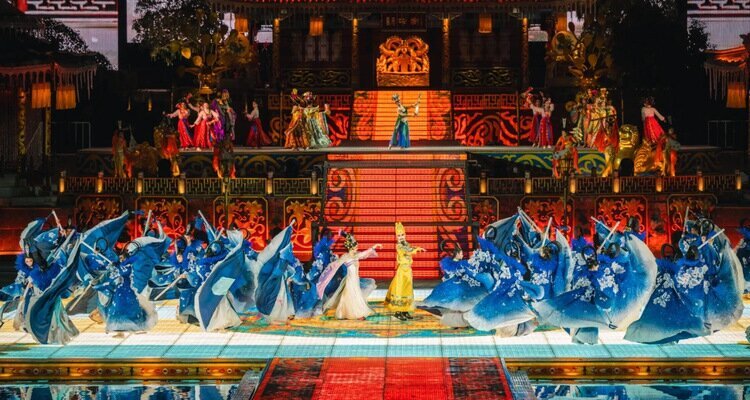 The show: "Song of Everlasting Regret"
In addition to visiting the beautiful scenery, the performances in Huaqing Palace are also very wonderful.
"Song of Everlasting Regret" is a wonderful audio-visual feast. With the real Lishan Mountain and the real water of Nine-Dragon Lake as the background, it presents the Li-Yang love story in front of you in the form of a song and dance drama.
This performance lasts for 70 minutes. All of the performance times are in the evening. The ticket prices range from CNY 248 to 988.
The higher the price, the better the seat. Tickets priced at CNY 398 and 588 are recommended as they offer good value for money. This performance is in Chinese, but the expressive performances and amazing visual effects also enable international tourists to appreciate and enjoy it.
Another performance, "The Xi'an Incident on December 12th", is an immersive performance. You are not only the audience but also the actors, which could enable everyone to have a deeper understanding of this historical event.
The performance lasts about 60–90 minutes and is entirely in Chinese. Therefore, it is only recommended for tourists who are proficient in Chinese and have an understanding of modern Chinese history to try it.
The Suggested Huaqing Palace Traveling Route
I recommend two routes for visiting Huaqing Pool:
Route 1: Enter from the west gate: According to the spatial order, first visit the Longevity Hall, the Frost Flying Hall, and Nine-Dragon Lake to feel the romantic atmosphere of the love story. Then, go to the Imperial Hot Spring Relics Museum to have an in-depth understanding of the royal bathing culture.
Next, visit Huan Garden and the Five-Room Hall to learn about the Xi'an Incident. Depending on your physical strength, decide whether to climb Lishan Mountain and then exit from the east gate, which is close to the east parking lot.
Route 2: Enter from the east gate: Also according to the spatial order, visit Huan Garden, the Five-Room Hall, the Imperial Hot Spring Relics Museum, the Frost Flying Hall, Nine-Dragon Lake, and the Longevity Hall.
If you want to climb Lishan Mountain, exit from the back of the Longevity Hall, go to the Lishan cableway station to take the cableway, and then get on the bus at the west parking lot after finishing the tour. That way, you wouldn't walk on the same road again.
If you enjoy tasting food, for example, dining at a restaurant overlooking the beautiful Huaqing Palace Square, see our 3-Day Xi'an Foodie Adventure.
Can I Enjoy Hot Springs in Huaqing Palace?
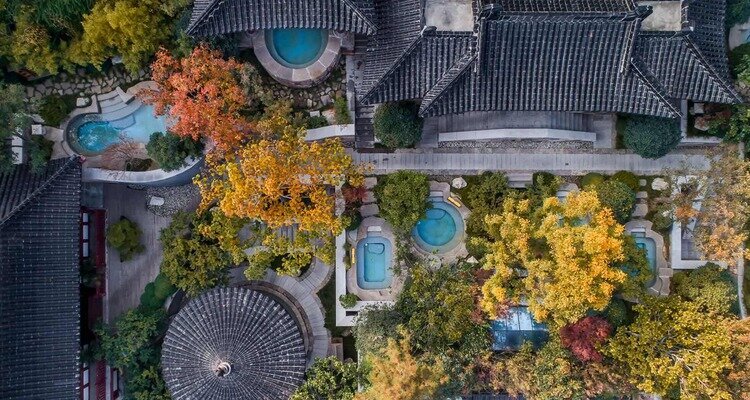 Huaqing Yutang Hotel
You could soak your feet in Huaqing Palace but couldn't take a hot spring bath. However, there are several hot spring hotels nearby, such as Xi'an Huaqing Yutang Hotel and the Aegean Sea Hotel. The price of hot spring bathing ranges from CNY 200 to 500, not including the room fee.
I think the most perfect way to visit Huaqing Palace is to admire the scenery in the palace during the day, enjoy the performance of "Song of Everlasting Regret" in the evening, and then take a wonderful hot spring bath.
If you would like to add Huaiqng Palace in your Xi'an itinerary, feel free to contact us.
Best Times to Visit Huaqing Palace
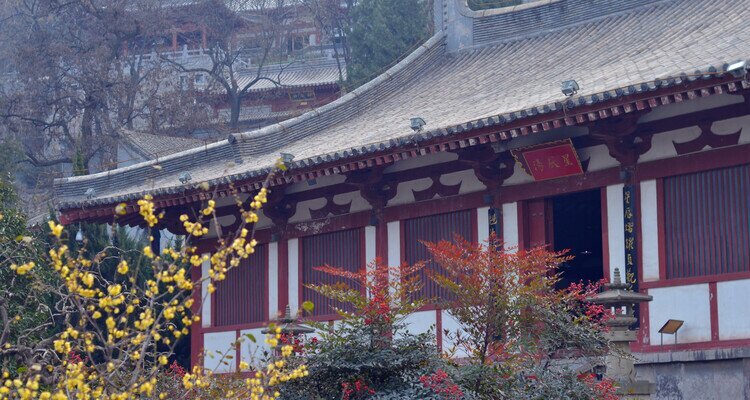 Huaqing Palace in autumn
Spring (March to May) and autumn (September to November) are the ideal seasons to visit Huaqing Palace. During these months, the weather is pleasant, with the temperature ranging from 15°C to 25°C (59–77°F). In spring, flowers are in full bloom, and in autumn, the leaves are colorful and the scenery is beautiful.
To avoid crowds, it is recommended to arrive when the palace has just opened in the morning. If you plan to watch "Song of Everlasting Regret", entering the palace at about 4:30pm could reduce the waiting time before the performance.
You could learn more Xi'an weather in our Best Times to Visit Xi'an
How to Get to Huaqing Palace
Public transportation: You could take Metro Line 9 to Huaqing Pool Station and exit from Exit B or C, but it is always very crowded.
Private car: It's about 35 kilometers (22 miles) from the urban area of Xi'an (about 40–50 minutes' drive) to Huaqing Palace, and if you want to be comfortable, this is the best traffic tool.
It's about 14 kilometers (9 miles) from the Terracotta Army Museum (20–30 minutes' drive) to Huaqing Pool. You could take local buses or taxis.