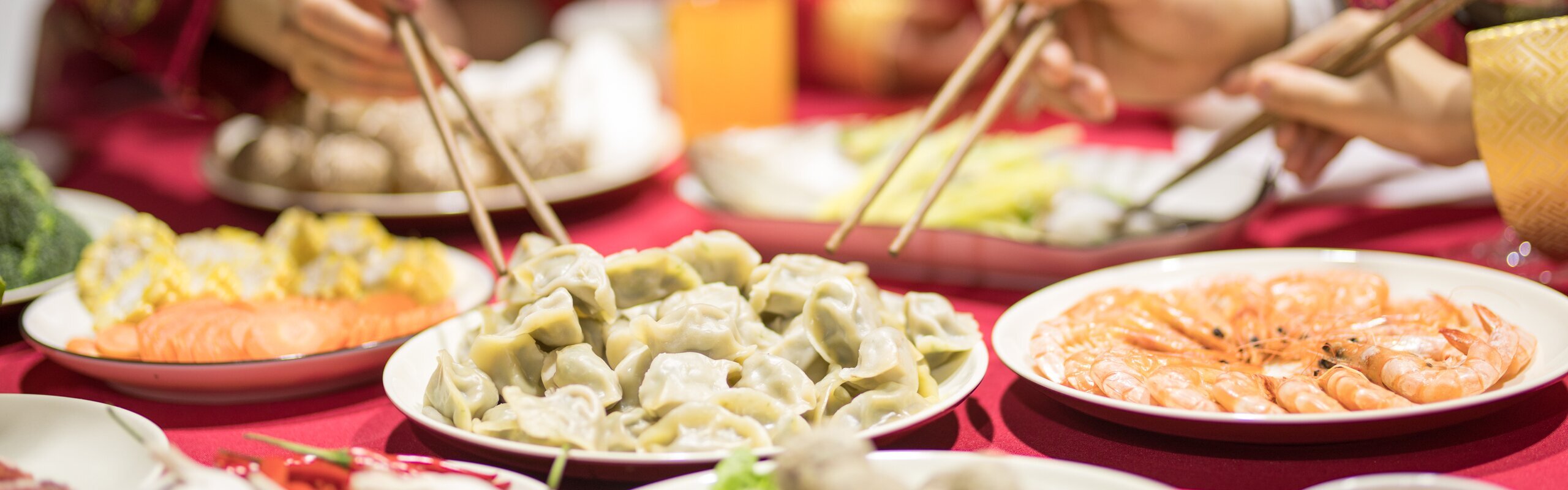

Dumplings are a famous traditional northern Chinese food. They are half-moon-shaped, soft, stuffed pasta - like ravioli. Dumplings are named according to their various fillings and cooking methods (fried, heated in boiling water, or steamed).
Dumplings have also become a common type of food in southern China, where people don't grow/eat wheat as a rule. "Southern dumpling" skins are typically made of rice.
An Important Chinese New Year Food
Dumplings are a traditional Spring Festival food in northern China, but not in the south. On the eve of the Spring Festival, dumplings have an irreplaceable place in many New Year's Eve banquets, though some areas choose to eat dumplings after New Year's Eve.
Dumplings are a representative Chinese cuisine, with both shape and filling having cultural meaning. That's why they're essential for some during Spring Festival, as they express their aspirations for a better life, and hopes for certain blessings.
Symbolizing Wealth
Eating dumplings at the Spring Festival is said to bring good fortune financially, as dumplings look like ingots (元宝), the currency used in old times.
Symbolic Dumpling Stuffings
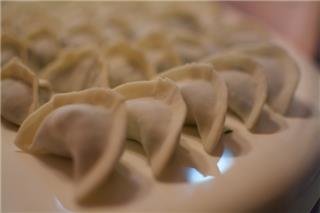 Chinese Dumplings
Celery stuffing represents industriousness and (resulting) wealth. Reason: 'Celery' (芹菜 qíncài /chin-tseye/) sounds like 'industrious wealth' (勤财 qíncái). Leek stuffing represents long-term wealth. Reason: 'Leek' (韭菜 jiǔcài /jyoh-tseye/) sounds like 'industrious wealth' (久财 qíncái). It also represents a wish for the family to be in good health, harmony, joy and happiness 久: 日久生情, 永久和平 'familiarity breeds fondness', 'enduring peace').
Cabbage stuffing represents the blessing for a well-off life for a hundred years. 白菜 báicài /beye-tseye/ 'white vegetable') sounds like 'hundred wealth' (百财 bǎicái). It also represents the enduring love between new couples (from the popular saying including : 白头到老 'white head until old'… to live in conjugal bliss until the white hairs of old age; "until death do us part").
Mushroom stuffing is the mascot for increasing wealth and luck. Reason: Mushrooms are shaped like an up arrow showing, for example, the stock market's growth, progress, increasing quality of life, or wishes for the younger generation to grow taller and improve in their studies, etc.
Fish stuffing means surplus wealth. Reason: 'Fish' (鱼 yú /yoo/) sounds the same as 'surplus' (余 yú). Eating fish dumplings means wishing you have a lot of remaining money. "年年有(鱼)余 'surplus year after year' " is a popular saying in China, which express a desire that expects every year remaining food.
Beef stuffing represents strong economic growth. The bull symbolizes strength, and is favored by stock investors. 'Bull market' (牛市) in Chinese refers to a period of rising stock prices. The popular saying牛气十足('bull energy ten sufficient') wishes good health and happiness.
How to Order Dumplings
Chinese dumplings (饺子jiǎozi /jyaoww-dzuh/) are a favorite with Westerners and some restaurants specialize in just dumplings.
How many dumplings to order: About 20 or 30 are usually enough for a meal, 40 if you're really hungry.
Dumplings are ordered in (traditionally bamboo) trays called long of 10 or 20 dumplings. So you can say yī lóng (一笼 /ee-long/ 'one tray'), followed by your choice of filling, to order.
Popular fillings include the standard minced pork (猪肉zhūròu /joo-roh/), as well as beef (牛肉niúròu /nyoh-roh/), cabbage (白菜báicài /beye-tseye/), and garlic and chives (韭菜jiǔcài /jyoh-tseye/).
See below for a sample dumping menu, with pronunciation and characters to recognize and point to. Click here for more on ordering food in China.
Chinese Dumpling (Jiaozi) Menu
| English | Chinese | Pronunciation | Characters |
|---|---|---|---|
| Pyramid dumplings | shuǐjīngjiǎo | shway-jing-jwaoww | 水晶饺 |
| Steamed dumplings | xiǎolóngbāo | ssyaoww-long-baoww | 小笼包 |
| Steamed dumplings | zhēngjiǎo | jnng-jyaoww | 蒸饺 |
| Dumplings in broth | shuǐjiǎo | shway-jyaoww | 水饺 |
| Fried dumplings | guōtiē | gwor-tyeah | 锅贴 |
| Steamed shredded seafood dumplings | sānxiānjiǎo | san-sshyen-jyaoww | 三鲜饺 |
| Shrimp dumplings | xiārénjiǎo | sshyaa-rnn-jyaoww | 虾仁饺 |
| Fried garlic and chive dumplings | jiǔcàijiǎo | jyoh-tseye-jyaoww | 韭菜饺 |
| Cabbage dumplings | báicàijiǎo | beye-tseye-jyaoww | 白菜饺 |
The History of Dumplings
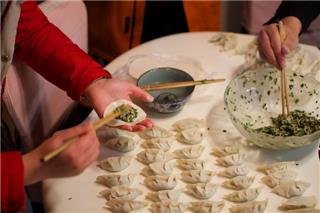 Making Chinese Dumplings
As early as the Three Kingdoms period (220–280), dumplings appeared.
Around the Tang Dynasty, dumplings took their present-day form, and were served on a plate as a dish.
In 1972, archaeologists in Turpan's Astana Tombs found a buried wooden bowl containing a dozen crescent-moon-shaped objects, resembling today's dumplings (recognized by experts as the Tang Dynasty's "prison pill" ). From this, we know the tradition of eating dumplings was passed to the Western ethnic minority areas 1,300 years ago.
Dumplings were popular in the Qing Dynasty (1644–1911), when dumpling restaurants could be seen everywhere, and the development of dumplings was greatest.
A businessman from the Qing Dynasty started a dumpling restaurant run by his whole family and passed down from generation to generation. This family traveled to different provinces, collating and integrating the principles and traditions of Chinese cooking.
Travel with Travel China and Taste Authentic Chinese Food
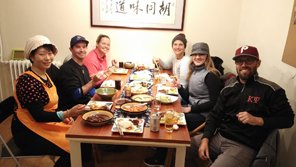 Enjoying Chinese food in a local restaurant
If you want to taste authentic Chinese cuisine, Travel China' food tours offer you an opportunity to eat local food while visiting China's most popular attractions.
See our most recommended Chinese food tour:
- The Flavor of China - a 12-day China cuisine tour
Or contact us and let us tailor-make a Chinese food tour for you according to your interests and requirements.