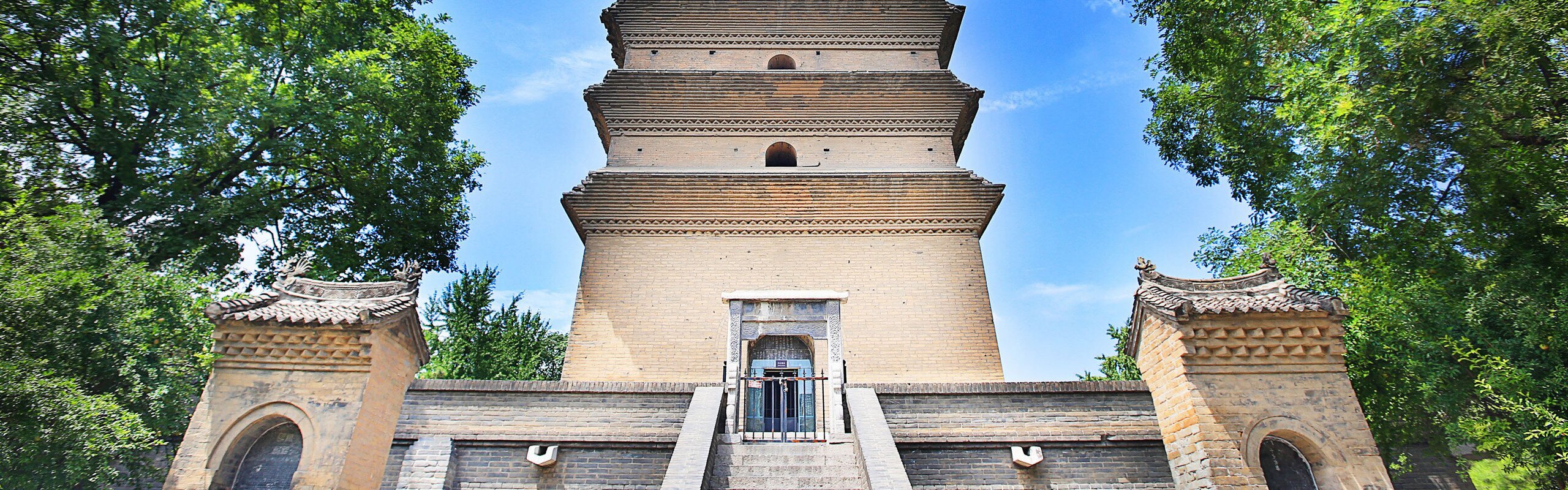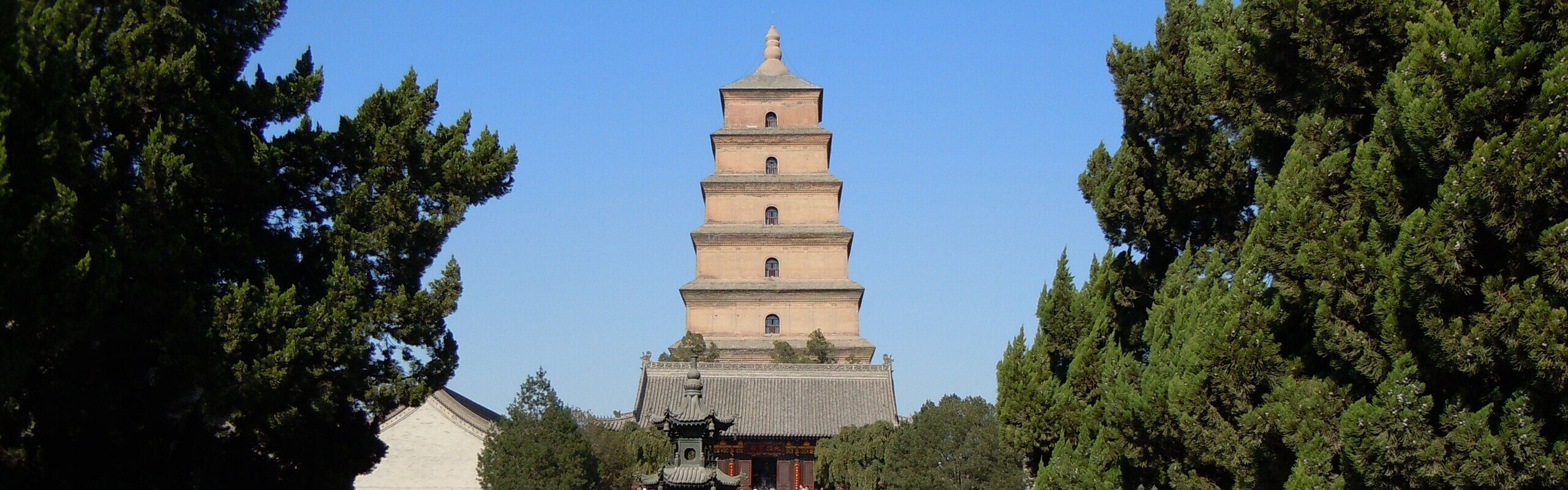

The Giant Wild Goose Pagoda, also known as the Big Wild Goose Pagoda (Dayan Pagoda), is a monumental Buddhist pagoda located in southern Xi'an and has been added to the World Heritage List.
It was built in 652 during the Tang Dynasty (618-907) to store the Buddhist scriptures and statues that the great monk Xuanzang brought back from ancient India. The pagoda was rebuilt in 704 during the reign of Empress Wu Zetian, and its exterior brick façade was renovated during the Ming Dynasty.
The Big Wild Goose Pagoda is almost a must-visit for tourists in Xi'an, as it is the largest and earliest Tang Dynasty square pavilion-style brick pagoda in existence. Its majestic tower features a pavilion-style design.
Facts about the Giant Wild Goose Pagoda:
- Opening Hours: 8:30 am - 5 pm
- Ticket Price: Adults: ¥10 ($1.5), Students: ¥5 ($0.7). Tower access tickets cost an additional ¥25-30 ($3.7-4.4).
- Reservation Required: No
- Height: The Big Wild Goose Pagoda is 7 stories high and 64.517 meters tall, with a base length of 25.5 meters.
- Recommended Visiting Time: 1 to 1.5 hours
- Location: No. 1 Ci'en Road, Yanta District, Xi'an City, Shaanxi Province (20 minutes drive from the city center)
Hi, I'm Ken. I've lived in Xi'an for more than 20 years, having arrived in 1999 to study. During my college years, I fell in love with Xi'an's rich history and vibrant culture. After graduation, I chose to stay and become a cultural ambassador, sharing the city's attractions and culinary delights with international visitors. My goal is to help everyone discover the magic of Xi'an and fall in love with it, just as I did.
Content Preview
- Differences between Giant and Small Wild Goose Pagoda
- What to do at the Pagoda
- What's Inside the Pagoda
- How to Get the Entry Tickets
- Best times
- What to do around the Pagoda
- Transportation
- Why Was It Built
What's the Difference between the Giant Wild Goose Pagoda and Small Wild Goose Pagoda?
There are two Goose Pagodas in Xi'an: the Giant Wild Goose Pagoda and the Small Wild Goose Pagoda. Both were built during the Tang Dynasty but have different histories.
The Big Wild Goose Pagoda was completed earlier, while the Small Wild Goose Pagoda was built slightly later. This difference in timing may be attributed to various factors, such as changes in imperial priorities or shifts in religious patronage throughout the dynasty.
They have different architectural styles. The original Small Wild Goose Pagoda was 15 stories high, but now only 13 stories remain, standing at 43.4 meters tall. It is a multi-eaved brick pagoda, while the Big Wild Goose Pagoda is 7 stories high and 64 meters tall, featuring a pavilion-style design.
The Big Wild Goose Pagoda has straight lines that make it look tall and sturdy. In contrast, the Small Wild Goose Pagoda has a slightly curved shape that gives it a more graceful feel.
Despite the differences, they both symbolized imperial support for Buddhism and the integration of religious practices into the state's cultural framework and are notable examples of such architectural marvels.
Which is More Recommended to Visit
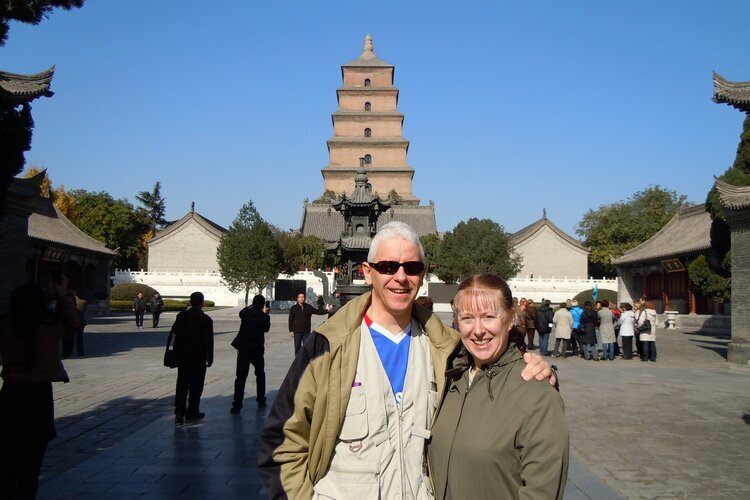 Our guests visiting the Big Wild Goose Pagoda in autumn
If you are short on time and can only visit one place, I recommend going to the Big Wild Goose Pagoda. It is climbable, allowing you to see some ancient artifacts, including original Buddhist inscriptions inside.
The construction of the Big Wild Goose Pagoda involved intricate engineering techniques and artistic craftsmanship. It is not only a functional building but also represents the pinnacle of architectural design during the Tang era. The materials used, structural integrity, and decorative elements all contribute to its enduring legacy.
Even today, this pagoda stands as a testament to the advanced building skills and deep spiritual beliefs of the people of the Tang Dynasty.
You can observe the detailed carvings and inscriptions that adorn the pagoda, providing insights into the religious practices and daily life of the time. The pagoda also serves as an important landmark, attracting scholars, pilgrims, and tourists who come to admire its historical and cultural significance.
If you have enough time, the Small Wild Goose Pagoda is also a good choice. It is located near the Xi'an Museum, allowing you to visit both sites in one trip.
What to Do at the Giant Wild Goose Pagoda
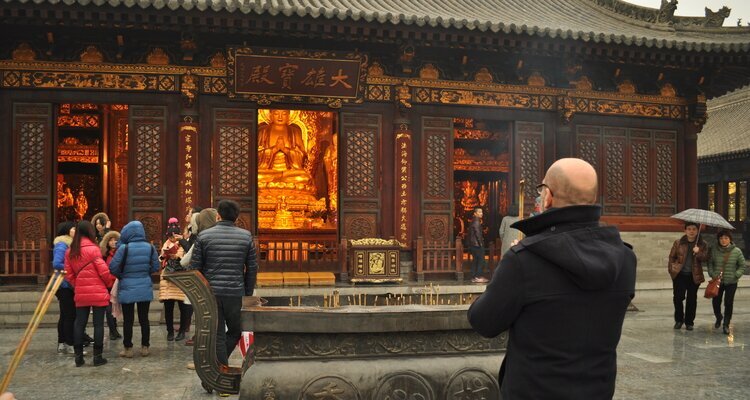 The Great Hall of Buddha
Visit the Big Wild Goose Pagoda for a stunning view of Xi'an from above, and take a moment to admire the original Buddhist inscriptions written in Sanskrit.
Within the Da Ci'en Temple, you can explore historic buildings such as the Great Hall of Buddha, the Bell Tower, and the Drum Tower. Don't miss the temple's garden, where you can experience the serene atmosphere of Tang Dynasty gardens.
Additionally, be sure to check out the pagoda forest, where the great masters of this temple are buried. Here, you will find stone tablets dating from the Tang Dynasty to the Qing Dynasty. These ancient tablets showcase the art of Chinese calligraphy and highlight the contributions of the esteemed monks to the temple and Buddhism.
Where to Take Good Photos:
- In front of the Xuanzang Master Statue
- The northeast entrance of the Grand Tang Dynasty Ever Bright City
- South Square of Joy City (You could use a telephoto lens to compress the scene, the stele, the Xuanzang Master statue, and the Big Wild Goose Pagoda together.)
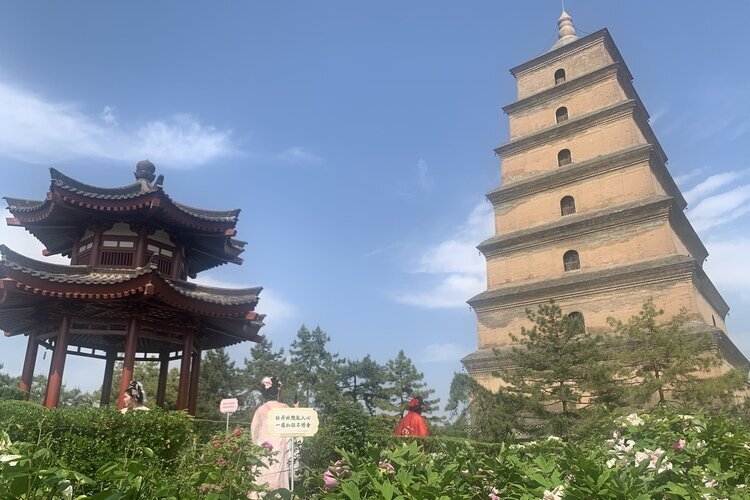 Big Wild Goose Pagoda taken at the southwest corner of Peony Garden
What's Inside the Giant Wild Goose Pagoda?
When visiting the Big Wild Goose Pagoda, climbing the tower is a must; otherwise, you'll miss many classic cultural relics.
- First Floor: On the south gate of the first floor, you'll find numerous inscribed tablets bearing the names of those who passed the imperial examination.
- Second Floor: A statue of Sakyamuni Buddha is located here.
- Third Floor: The birch bark scriptures brought back by Xuanzang are displayed on this floor.
- Fourth Floor: This floor houses important relics.
- Fifth Floor: You can see Tang Dynasty lotus-patterned square bricks and wind chimes.
- Sixth and Seventh Floors: These floors serve as observation decks, offering views of the musical fountain and the Ever-bright Tang Mall.
For the best photographs, position yourself at the south gate with Xuanzang's statue, or capture the Buddha statue in the Da Ci'en Temple Ruins Park next door.
If you are in good health, I highly recommend climbing the tower. There is an additional charge of 25 yuan (3-4 USD) per person for the climb. Inside, you'll navigate a wooden staircase with 256 steps, and the visit takes about 20 minutes.
Recommended Xi'an Tours:
- 3-Day Xi'an Foodie Adventure
- 4-Day Xi'an and Huashan Mountain Tour
- 8-Day Beijing – Xi'an – Shanghai Highlights Tour
If you want to add the Big Wild Goose Pagoda to your trip, feel free to contact us. Our itineraries are customizable and adjustable.
How to Purchase Entry Tickets
- Ticket Price: Adults: ¥10 ($1.5), Students: ¥5 ($0.7). Tower access tickets cost an additional ¥25-30 ($3.7-4.4).
Tickets can be purchased directly at the venue, and no advance reservation is required.
Best Times to Visit the Giant Wild Goose Pagoda
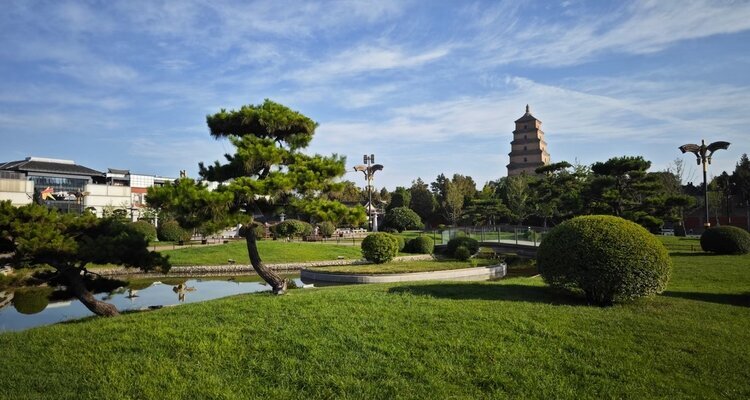 Big Wild Goose Pagoda taken from the northeast entrance of the Grand Tang Dynasty Ever Bright City
The ideal times to visit the Big Wild Goose Pagoda are in spring (April to May) and late autumn (November).
During spring, the temple's peony garden bursts into bloom, showcasing a stunning array of peonies in various colors. In late autumn, the persimmon trees are laden with ripe fruit, creating a unique and picturesque scene.
For the best experience, visit in the morning (8:30 am-9 pm) or in the afternoon (4 pm-4:30 pm).
In the morning, if you're lucky, you might catch monks reciting sutras in the temple. While the monks' chanting schedule isn't fixed, it typically occurs shortly after the temple opens, when there are fewer tourists and less distraction.
After your visit to the pagoda, consider taking a stroll around the nearby the Grand Tang Dynasty Ever Bright City in the evening. As night falls, the lights there illuminate the area, creating a beautiful and enchanting atmosphere.
You could find more Xi'an weather information on our Best Times to Visit Xi'an.
What to Do Around the Giant Wild Goose Pagoda
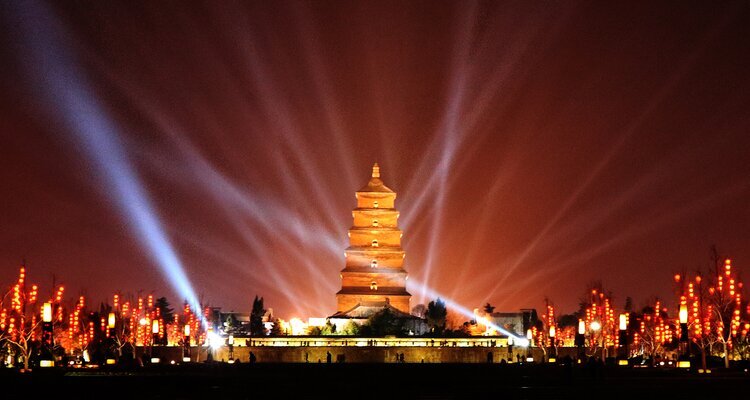 The Giant Wild Goose Pagoda at night under the light of the Grand Tang Dynasty Ever Bright City
After visiting the Big Wild Goose Pagoda, head to the Grand Tang Dynasty Ever Bright City, especially in the evening when it's at its most beautiful. The area comes alive with colorful lights and captivating shows, including performances inspired by the Tang Dynasty.
Be sure to sample some delicious local cuisine as you stroll along the streets and take in the stunning views. Don't forget to capture these moments with photos!
Additionally, nearby Joy City offers great shopping and dining options. You can find several Shaanxi-style restaurants. One of my favorites is "原来宝鸡," which serves fantastic BiangBiang noodles and Chinese hamburgers.
For more ideas about planning a Xi'an itinerary, check out our Ultimate Xi'an Itineraries.
How to Get to the Giant Wild Goose Pagoda
The Big Wild Goose Pagoda is situated in a bustling area, and traffic can become quite congested during holidays and weekends.
Since it is a bit far from the nearest subway station, traveling by private car is recommended. This way, you can be dropped off close to the pagoda and easily picked up after your visit.
If you prefer to take the subway, you can exit at Big Wild Goose Pagoda Station on Line 3. From Exit C, it's approximately 985 meters (0.6 miles) to the pagoda.
Why Was the Giant Wild Goose Pagoda Built?
The Giant Wild Goose Pagoda was constructed during the Tang Dynasty to facilitate the study and translation of Buddhist scriptures.
Over the centuries, the pagoda has endured significant damage from weather, wars, and seismic activity, which has led to the loss of much of its original materials. Despite this, the pagoda remains a prominent structure of its style and significance.
The Tang government commissioned the construction of the pagoda to house a chamber for translating Buddhist texts, in hopes of persuading the renowned monk Xuanzang to lead the temple.
Xuanzang was a pivotal figure in Buddhism; he traveled to India to study and translate Sanskrit scriptures, and he developed influential theories on consciousness, karma, and rebirth that were later adopted by various schools of Buddhism.