
Dragon dances have been indispensable to Chinese festivals since ancient times. With the spread of Chinese people and culture all over the world, the dragon dance has been brought to every corner of the world where there are overseas Chinese gathered. It has become a symbol of Chinese culture.
Content Preview
- Dragon Dance Symbolism and Meanings
- Chinese New Year Dragon Dances
- The Dragon Dance Costume
- A Typical Dragon Dance
- The History and Legend of Dragon Dances
- Dragon Dance Types
Dragon Symbolism and Dragon Dance Meanings
The Chinese dragon is a symbol of China, and it is an important part of Chinese culture. Chinese dragons symbolize wisdom, power, and wealth, and they are believed to bring good luck.
In ancient times, when there was no rain for a long time, people prayed for rain with a dragon dance, and dragon dances after planting were also a way to pray against insect attacks. Nowadays, dragon dances are performed during festive occasions as a means to chase away evil spirits and welcome in prosperous times.
Dragon dances can be performed in a variety of ways with dragon costumes of different colors. Different colors of dragon dance have different meanings.
- Green symbolizes a great harvest;
- yellow symbolizes respect for the empire;
- gold or silver symbolize prosperity;
- red is used to create excitement and usher in good fortune.
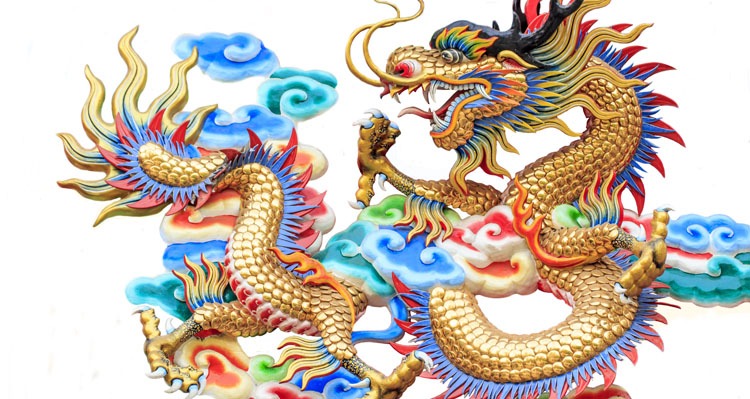 A Chinese dragon
Chinese New Year Dragon Dances
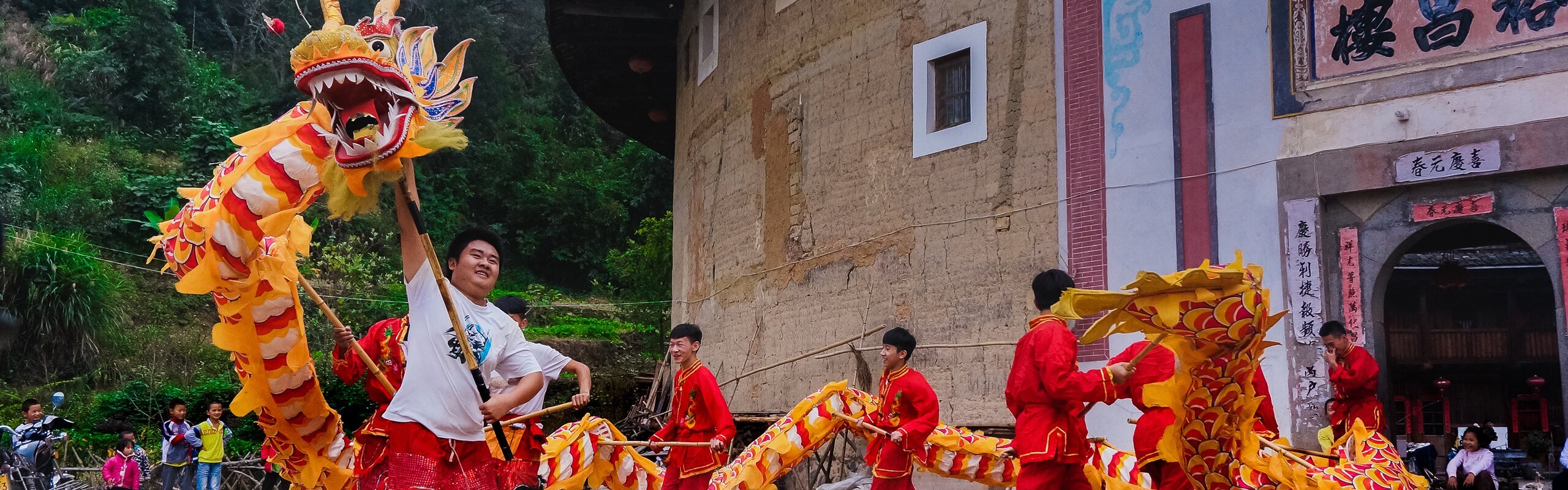
Dragon dances are an important part of the Chinese New Year celebrations. Along with lion dances, they are often the highlight of Chinese New Year parades.
From Chinese New Year's Day to the Lantern Festival, dragon dances can be seen in many places in China and Chinatowns around the world. They are believed to be a way to scare away evil spirits and bring good luck to people. It is considered lucky if one is touched by a (dragon dance) dragon.
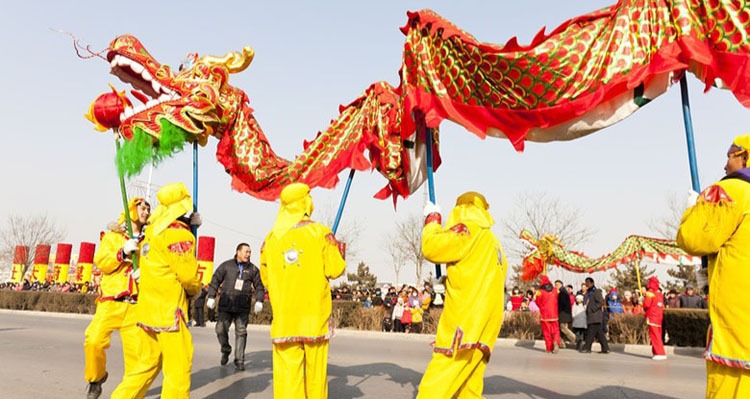 Chinese New Year dragon dance
The Dragon Dance Costume
The dragon body of the dragon dance costume is composed of a large dragon's head, and a long tail-like body in a number of sections, which are lifted on poles. The length of the dragon can vary from 2 meters to 100 meters or even over 1,000 meters long. It is believed that the longer the Dragon is, the more luck it will bring!
Odd numbers of the dragon's joints are regarded as auspicious, so people often make a 9-jointed dragon, an 11-jointed dragon, a 13-jointed dragon, or even a 29-jointed dragon.
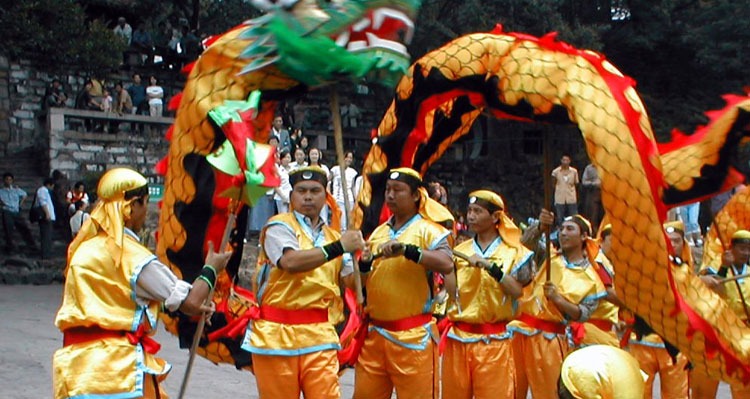
The dragon dance costume is made of various materials like grass, bamboo, paper, and cloth. The dragon body is woven in a round and tubular shape using thin bamboo strips, segment-by-segment, and covered with a huge red cloth with dragon scales decorating it.
Dragon dancers often wear long trousers that perfectly match the body of the dragon.
A Typical Dragon Dance
The dragon body used for the dragon dance is usually placed in a local 'Dragon King Temple', and only on the day of the dragon dance can it be taken out, accompanied by local people holding banners and flags, pounding on drums, and blowing trumpets. People connect the head and the tail of the dragon to its body and hold a ceremony of 'eye-pointing'.
A person holding a rod with a big ball (called the 'Pearl of Wisdom')at the top leads the dragon during the dance. The ball is moved left and right, back and forth, up and down, and the dragon follows the ball. Its body, moving in waves, appears to be dancing. The pursuant movements of'Dragon Chasing the Pearl'symbolize that the dragon is continually in pursuit of wisdom.
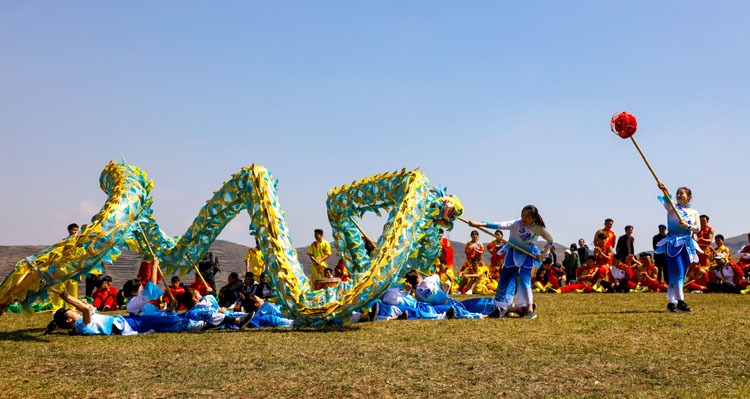 Chinese dragon dance
The choreography of a dragon dance varies according to the skills of the performers. Common movements include 'cloud cave', 'whirlpool', 'tai chi pattern', 'threading the money', 'looking for the pearl', and 'dragon encircling the pillar'.
After dance, the dragon's head and tail are burnt, and the body is returned to the temple, where it will be kept for use the next year.
The dragon is welcome everywhere it goes, and sometimes the team conducting the dragon dance can receive banquets up to five or six times, which are called 'dragon in exchange for wine'.
The History and Legend of Dragon Dances
The origin of the dragon dance can be dated back to the Han Dynasty (206 BC–220 AD). It was then used in a ceremony for worshiping ancestors and praying for rain, but it gradually developed into an entertainment activity. By the Tang Dynasty (618–907)and the Song Dynasty (960–1279), the dragon dance had become a common ceremonial activity in festivals like Chinese New Year.
Legend has it that a long time ago, in a village called Lotus, there was a pond covered with lotuses. A woman who lived by the pond was pregnant for 999 days and gave birth to a boy. Surprisingly, on the boy's chest and back there were thin dragon scales, glittering and dazzling. When the old chief heard that the woman had given birth to a dragon god, he wanted to kill the baby. The woman put her baby in a foot basin and hid him in the lotus pond.
However, the old chief found the baby and he raised his dazzling knife and slashed at the child.
In a flash, the child jumped up from the foot basin, turned into a golden dragon, and leaped into the pool. Suddenly, the wind blew and dark clouds rolled in. Then the little dragon gradually grew larger and turned into a dragon of tens of feet long.
From then on, whenever there was a drought in the village, the dragon came to give rain. In order to thank him, the local people used 999 lotus petals to make a flower dragon and performed a dragon dance every Spring Festival (Chinese New Year).
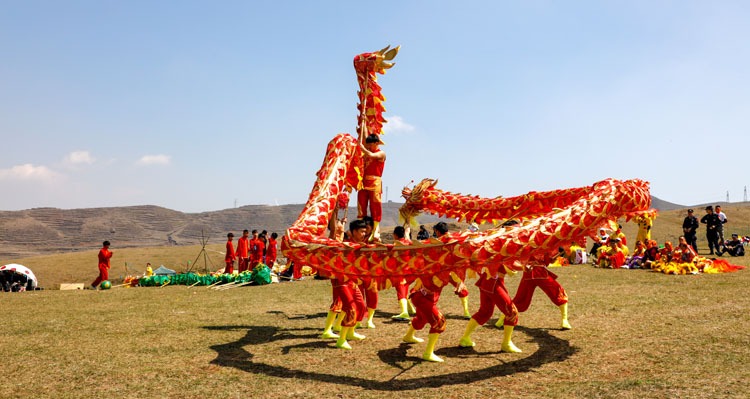
Dragon Dance Types
Southern Dragon Dance
The southern dragon dance originates from areas south of the Yangtze River. The body of a southern dragon is more finely decorated and heavier than a northern dragon's.
The southern style emphasizes momentum, strength, and a grand appearance, so it does not display agile movements. Usually, 10 people are needed to carry a southern dragon. It is conventionally made of bamboo and paper, and the body's skin is made of cloth with dragon scales drawn on it.
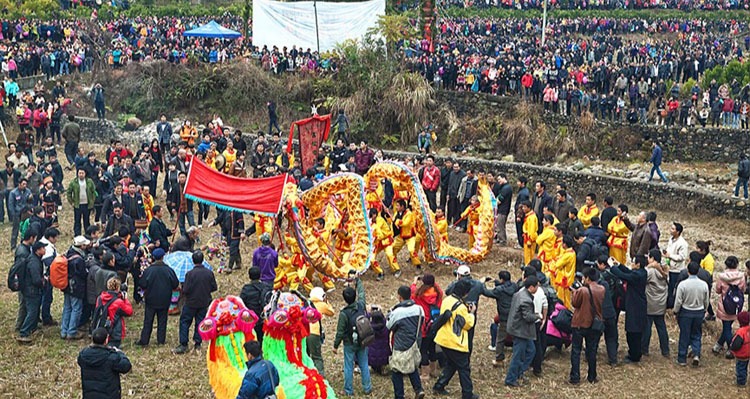 Southern dragon dance
Northern Dragon Dance
This style was developed north of the Yangtze River.
The body and head of a northern dragon are smaller than that of a southern dragon, and are made of paper or plant fibers, which make it considerably lighter. Northern dragon dances are often performed in a dark environment, so northern dragons are usually made with fluorescent materials.
Different from the southern dragon, which displays strength and grandeur, the northern dragon emphasizes flexibility in its dancing moves. The northern style is more similar to lion dances'.
At present, the northern dragon is more popular worldwide. Competitions and performances are frequently held in China, Hong Kong, Malaysia, and Singapore.
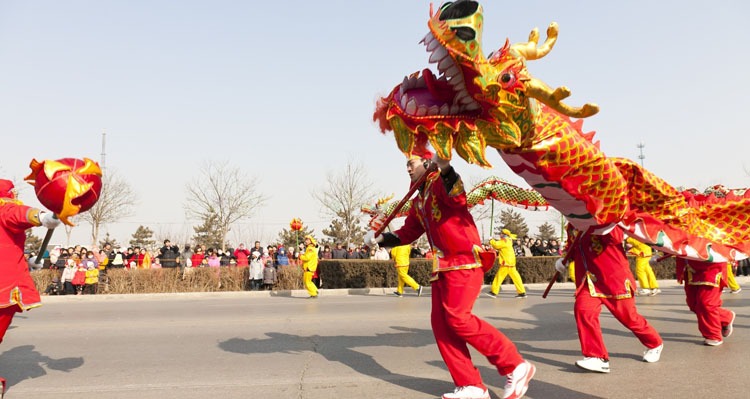 Northern dragon dance